Leslie contemplated the bowl of porridge in front of her unenthusiastically, then sighed and picked up her spoon. Doctor’s orders. While spooning the tasteless mush into her mouth with one hand, she scrolled on her phone with the other, vicariously devouring photos of sumptuous breakfast recipes. Quesadillas stuffed with fluffy scrambled eggs and melting cheese, smoked salmon omelette with freshly ground black pepper, French toast with cinnamon and vanilla. She longed to savour the flavours: creamy avocado, fiery chili, the decadent sweetness of maple syrup.
Rick came into the kitchen, and she swiftly pushed the phone under a pile of unopened Christmas cards. He greeted her with a cheerful ‘good morning’, accompanied by an irritatingly paternal nod of approval at seeing her eating her porridge. His face was so similar to his father’s that looking at it caused her a stab of pain. Two days ago she hadn’t realised he was in the room with her until she suddenly caught sight of him in a mirror and almost jumped out of her skin. It was like seeing a ghost.
Rick filled a bowl of cornflakes and poured himself a cup of coffee, sat down at the table and promptly started scrolling on his own phone while he shovelled in the food. Leslie gritted her teeth in annoyance at the bursts of noise – jarring laughter, engine sounds, fragments of over-excited speech – as he scrolled through his social media. When Rick was little, the three of them had sat at the table eating breakfast together, talking about the day ahead. When he went through the teenage phase of trying to wear his iPod at the table, she and Brian had sternly put a stop to it. But her little boy was now a grown man with his own job, and a guest at her table. Not only that, he was doing her a favour by staying a few days with her, making up for the fact that she would be alone for Christmas, while he and his wife Sue went to celebrate with his in-laws. When Rick had first suggested the plan back in November, Leslie had been almost pathetically grateful. It was infinitely better than their initial, well-intentioned offer of her coming with them to Sue’s family. Horrified by the thought of being thrust into sudden intimacy with strangers and – even worse – having to choke down a doom-laden procession of greasy, tasteless Christmas dishes botched by an amateur cook – Leslie had frantically searched for some plausible excuse, until a lack of room at Sue’s mother’s house conveniently solved the problem for her.
Now, however, after three days of Rick’s presence in the house, Leslie was counting down the hours until he left. Although she found it profoundly irritating that someone who could never pick up his own clothes or clear his own plate without being nagged was now tutting at the state of her cupboards and shaking his head in disappointment at every mouthful she left uneaten, she had mostly enjoyed his visit. It had been a joy to have someone to cook for again, and his pleasure in the food she prepared had made it a little easier for her to get down a meal herself. They had leafed through albums, reminisced about family holidays, renewed old debates during lingering long walks in the slanted beams of the winter sunlight. Sweet as Sue was, she couldn’t help but be an outsider, and Leslie had enjoyed having her son to herself for a change.
But every evening, after they had said goodnight and gone up to bed, Leslie lay awake for hours, her stomach clenched in dread. Rick hadn’t stayed overnight in the house since he had moved out, let alone in the past year. He had no idea at all about what went on at night.
Sweating in trepidation, she listened intently to every creak and squeak in the old house. Was that the scrape of a foot in the hallway, a faint clang in the kitchen? Her heart was in her throat, her muscles protesting from being poised to dash out and intercept Rick if he got up to investigate. He must not find out. The consequences were unthinkable. After three sleepless nights, Leslie was desperate. She must get him out of the house, so she no longer needed to worry about him. She mustn’t let anything show, not a hint that might make him insist on staying on to look after her, make him doubt whether she would be safe left alone at Christmas. He had already rather pompously voiced his concerns about her being ‘without a man in the house’. She had suppressed a smile at the idea that Rick, a gentle, middle-class liberal accustomed to resolving conflict via respectful discussion, would be more capable of dealing with a burglar than she was, simply by dint of his possession of a Y chromosome. She at least was used to dealing with aggressive personalities and enduring the pain of burns and cuts, while Rick fussed endlessly if he nicked himself while shaving.
She was going to be alone at Christmas, for the first time in her entire life. Childhood Christmases had naturally been with her parents, amid varying constellations of their extended family. As a student, she had spent a few rebellious Christmases with friends, taking cheap flights to explore various European capitals, immersing themselves in the sights, sounds and – most importantly – the tastes of different cultures. Starting out in her career as a chef, Christmas had been a time to work. Exhausting hours in a hot, steamy kitchen slaving to make other people’s Christmases merry. Then after the shift was over, when she really should have collapsed into bed, letting off steam in riotous celebration with the other kitchen staff. After she met Brian and had Rick, Christmases became a frenetic juggling act between work and family, until achieving the dream of her own restaurant finally brought some measure of control. After Rick left home to study, she and Brian had even managed the occasional Christmas Day to themselves. Leslie had taken delight in crafting elaborate and unusual dinners, replacing the traditional heavy fare with numerous small courses, the delicate flavours of the dishes contrasting and harmonising into a festive symphony for the tastebuds.
Then the coronavirus hit.
Leslie had to shut down her restaurant, send her workers home. Three weeks closure! It was unthinkable, an eternity in the hospitality sector. Then the weeks stretched into months, and she had been forced to let some staff go, each redundancy like a knife in her heart. She had often wished for more time alone with Brian. Now it seemed like an evil genie had granted her desire, only twisting it, as was customary in the fairytales, to turn the blessing into a curse. Used to spending most of the day away at their respective jobs before coming together in the evening to happily chew over the day’s events, the constant proximity, with nothing new to say, grated on their nerves until they got irritable and snappish with each other. She loved Brian deeply, but cooking was her life. Cooking for the same two people, day in, day out, with the basic supplies they could afford on their reduced budget – when the supermarkets hadn’t run out of them – could never compare to the frenetic energy of a working kitchen, the well-oiled team working together, the incredible pressure combined with the joy of having once more created a culinary delight, the pleasure at hearing the effusive compliments of the diners.
When the option to open for takeaways came, Leslie had at first been extremely reluctant. Pile the food into Styrofoam containers, to be jumbled any which way and arrive on the table lukewarm and past its best? It was like stuffing a Picasso into an envelope to post it to an art-lover. But Brian had persuaded her that it was better than nothing. And it had been some solace to cook properly again, to see at least some of her staff and know she was aiding them financially. To hear the immense gratitude of customers who were so ecstatic with any ray of light in their dismal lives that they never even noticed the poorer quality of the food. She remembered once hearing that in the seventeenth century there was scarcely a division between botany, cooking and medicine, the disciplines overlapping and influencing each other. It did seem that the food she provided had some healing power, for the soul at least if not the body.
Until the inevitable happened.
Brian was the first to complain of a headache and stomach pains. Not classic coronavirus symptoms at all, so neither of them was at all prepared for the positive test results they both received. Frustrated at the limitations of quarantine, Leslie counted down the days until they would be freed from their renewed captivity. Perhaps in two weeks she would be able to resume work again.
But two weeks later Brian was dead.
And Leslie was left not only bereft of her husband, but of her sense of smell and taste.
At first she was too filled with grief at losing the man she had loved dearly for more than twenty years to think through the implications of a loss that seemed insignificant in comparison. The massive hole he left in her life took all her attention. No more wry humour. No loving caresses. No calm common sense, no quiet support when despair threatened to overwhelm her. No joyous celebration of their successes, big or small.
It was only when she returned to work that she realised her career was also wrecked. The skills and experience she had developed over many years allowed her to keep cooking to a high standard, but her edge was gone. Unable to decipher the aromas, to sample the flavours, deprived of the feedback loop she needed to experiment and adapt, she was reduced to cooking like a robot on repeat. The pandemic ended and the restrictions were relaxed, but for Leslie, the damage was fatal. She sold the restaurant months later. Not for anywhere near as much as she would have got in its heyday, the increasing fuel prices were taking their toll on a sector already sorely beaten by the pandemic. But it was enough to tide her over until she could decide what to do to fill the yawning abyss in her existence. And now it was the first Christmas since Brian’s death.
Rick insisted on staying on for lunch, even though the pre-Christmas traffic was already building up on the roads. Leslie prepared his favourite pesto panini and he tucked into it with gusto while she picked at her plate. The bread crunched between her teeth and the tomato squished in her mouth, she could feel the squeaky stretchiness of the cheese and the softness of the pesto paste, even the small hard flakes of chili on her tongue. But she tasted nothing. No umami of tomato, no fresh sweetness of basil, not even the tang of the goats cheese she had always used instead of mozzarella, which even in her best days had tasted of very little to her.
While Rick gathered together his things and took a last look around the house, clearly reluctant to leave, Leslie’s anxiety grew. She had to restrain herself from chivvying him out of the door, which would be guaranteed to make him suspicious. He had already commented on her furtive behaviour earlier, but fortunately put it down to secret Christmas preparations. Now, on the threshold, he paused. ‘I hate to think of you here all alone’, he said. ‘It’s spooky, all those empty rooms. I kept thinking I heard noises in the night. You should sell up maybe, get something smaller. Near us perhaps?’. Leslie thrust down her sense of panic at his words and manufactured a gently mocking smile. ‘Come on now, you haven’t persuaded yourself there are gremlins under the bed again, have you? We should’ve never let you watch that film when you were little’. Rick had to laugh at the memory of himself as a terrified nine-year old, insisting on his parents checking under the bed each evening for at least a month. Leslie continued, ‘What sort of father will you make? It’s going to have to be you checking under the bed from now on, you know’. As she had hoped, the allusion to Sue’s pregnancy diverted his thoughts to a different set of family responsibilities, and she was soon waving him off as he backed his car out of the drive. Seeing him disappear around the corner of the street, she heaved a sigh of relief.
Walking into the house, she felt at a loose end. Rick’s visit had temporarily plugged the gap left not only by Brian’s absence, but by her loss of smell and taste. She had never realized before how many of her hobbies relied on it. Baking and cooking had lost their interest for her now that consuming the results had become more of a chore than a pleasure. Tending her garden was far less attractive without the fragrance of flowers, earth and grass, and the pondering of new ways to use the herbs and vegetables in her dishes. Even her favourite books were alien to her without the subtle, comforting scent of the old pages. Christmas itself seemed less magical without its accompanying bouquet: that unique combination of the sprucy scent of the tree, the cinnamon, clove and cardamom of the gingerbread house, the berry-scented candles permeating the whole house. How was she going to while away the hours until evening? At the thought of the approaching night, a shiver ran down her spine.
Now that she was alone, Leslie didn’t have any interest whatsoever in an evening meal. But the need to regularly hitch up her trousers remind her of the increasing gap between her waistband and her waist, and of the lecture she would receive if her weight had further dropped by her next doctor’s appointment. So she mechanically prepared food, slicing onions, tipping them into the pan while she chopped the vegetables, mentally reminding herself to keep checking the pan, as she could no longer rely on her nose to warn her when the onions began to brown. She had burned food several times in the last months. She didn’t bother with garlic or herbs anymore, nor with a glass of wine with the meal. Desserts, biscuits and chocolates belonged to the past, along with savoury snacks like crisps and cheese. A waste of money and an unnecessary intake of unhealthy fat and sugar when she no longer derived any pleasure from consuming them. Food was now purely functional, a balance of the nutrients she needed. Sitting down, she went through the process of cutting, chewing and swallowing. Shorn of the flavours that distracted from the raw physicality, eating was no more than a bodily function, like going to the toilet except that matter was ingested rather than expelled. At the worst moments, the act of mastication seemed disgusting to her, almost obscene. The squelching sounds, the gluey textures as food was ground between her teeth, the pulp moving down her throat.
The evening wore on, and darkness fell. Leslie tried to settle down to a book, a TV show, music. But her ears kept picking up imaginary noises from the hallway, her eyes spotting illusory shapes in the shadows. Finally, she couldn’t bear it any longer, and she went up to bed. She tried to lie as still as possible, ears pricked up to catch any sound, hardly daring to breathe. Fear gripped her. There had been nothing, the last three nights. Would it happen again now, with Rick gone? Or was it over? The seconds, minutes and hours ticked by, and she kept her eyes wide open.
There! – a chink from the kitchen. A scraping sound. Footsteps. She could tell from the sound when they moved from the tiled floor of the kitchen to the polished wood of the dining room. She jumped out of bed and ran softly down the stairs, then hesitated at the doorway, her heart beating wildly, her breathing ragged. Light shone through the gap under the door. Leslie gathered all her courage, then pushed it open slowly.
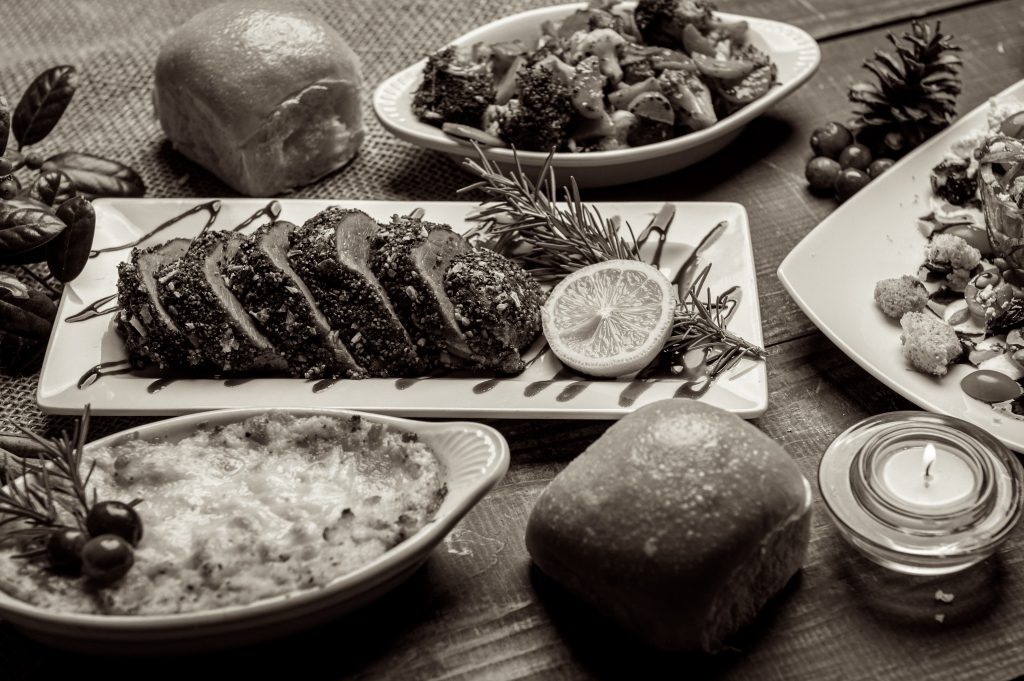
The ingredients were laid out in perfect order on the counter, as always. Basil leaves neatly nipped from their stems, finely chopped garlic in a dish, asparagus, onions and red peppers sliced into equal strips. Two steaks lay ready on their own chopping board, peeled potatoes were waiting in a bowl of water. Tears filling her eyes, Leslie lifted the herbs and inhaled deep, revelling in the potent aroma. Then she set to work with gusto, heating the oil, thinly slicing and frying the potatoes with a dash of salt and paprika, searing the meat to perfection, frying the garlic and toasting the spices until the aroma started to come free, then swiftly adding the vegetables and herbs.
Leslie was concentrating on laying the food out in an artistic pattern on the warmed plates when the voice from the dining room called through, reminding her in cheery tones not to faff too much about how the food looked. Laughing, she answered, for the hundredth time, ‘the better it looks, the better it tastes!’. She carried the plates through into the dining room, pausing briefly to inhale the fragile scent of the boughs of the Christmas tree. Then she put the food down on the table, one plate for her, one for Brian, sitting in his usual seat. Her heart leapt at the sight of his familiar features, his face wreathed in smiles. They toasted each other, and drank deep. Leslie appreciated every nuance of the wine. Sour cherry, redcurrants and strawberries, followed by a deep aftertaste of black pepper and liquorice. She bit into a forkful of meat, relishing the burst of flavour from the spices, the salty sweetness of the succulent, juicy meat. She closed her eyes to concentrate on the exquisite taste. A hand gently touched hers, and she held on to it tightly, wishing she could hold this moment for ever.
According to all the tales, haunting was supposed to be a terrifying experience. But Leslie’s only terror was that one day this haunting might cease.